Michael Vass
Introduction to Meter
Meter is a pattern of stressed and unstressed syllables that, though it often appears in poems, is difficult to explain. What is uniquely difficult about meter is that it influences and is influenced by form, lineation, and word choice. Additionally, many poems vary the metrical pattern, making it harder to distinguish the variation from the overarching pattern. However, I seek to provide an effective and efficient overview of meter, with the help of Mary Oliver’s book Rules for the Dance to help people read and write metered poetry.
Stress
Stress has a unique definition in poetry, denoting that the syllable is emphasized. This emphasis contrasts with unstressed, meaning that the syllable is not emphasized. The combination of stressed and unstressed syllables creates a metrical foot. Oliver elaborates on this basic definition, saying that “each foot is constructed of a single emphasis plus details–that is, [only] one heavy stress [with] whatever light stresses are needed to make up the chosen pattern,” which will be discussed in the next subsection (11). When reading poetry, these metrical feet can be uncovered through scansion, the act of writing the meter of a poem, using a macron (´) to denote a stressed syllable and a breve (˘) to denote an unstressed syllable (Oliver 10). After scanning through a line or two, a pattern may emerge (Oliver 11, 89), which will be discussed in the following subsection.
The Usual Suspects
In meter, there are several common patterns: iamb (iambic), trochee (trochaic), dactyl (dactylic), and anapest (anapestic), with the iamb being the most common foot “in English metrical poetry” (Oliver 7, 19). An iamb is an unstressed syllable followed by a stressed syllable. A trochee is the opposite of an iamb, a stressed syllable followed by an unstressed syllable. A dactyl has three syllables, the first being stressed and the latter two unstressed. An anapest is the opposite of a dactyl, with the last syllable being stressed. To solidify these ideas, read the following excerpts from poems, which Mary Oliver quotes and scans, before continuing to the next section.
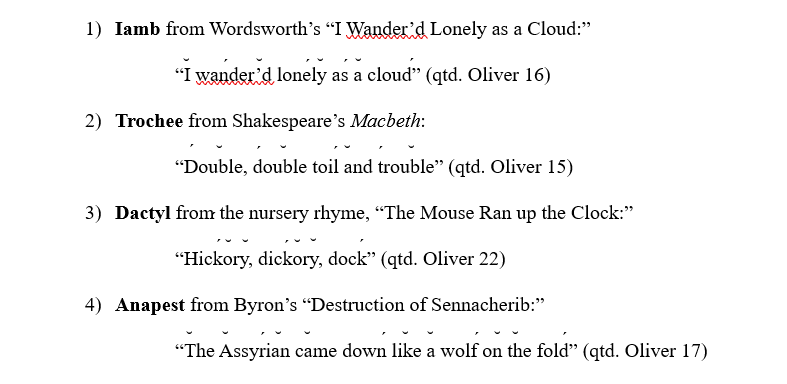
The changes in meter for the dactylic made by “dock” will be discussed in the later flexibility section.
The Meter Meets the Line
Meter, as previously stated, is intrinsically connected with lineation. While meter is commonly described as iambic or trochaic, this designation provides an incomplete picture of the poem, as it does not specify how many feet per line. In other words, designations like iambic do not tell the reader how many iambs are in each line. This missing description is provided by technical terms (refer to the list below this paragraph), such as pentameter, which means there are five feet per line. In scansion, these feet are separated by vertical bars (|), as seen in subsequent examples (Oliver 13). When these types of words are joined to the metrical pattern, a fuller picture of the poem emerges. For example, iambic pentameter means there are five feet per line, and the iamb is the metrical foot.
- Monometer: One foot per line
- Dimeter: Two feet per line
- Trimeter: Three feet per line
- Tetrameter: Four feet per line
- Pentameter: Five feet per line
- Hexameter: Six feet per line
Metrical Flexibility
In the previous examples, except for number three, the poems did not deviate from the common metrical patterns. However, many poems do so in several ways, such as uncommon metrical feet, “substitution of one meter for another[,] . . . tags[,] . . . [or] impure meter” (Oliver 22). These variations will be explored in the rest of this section.
Uncommon Meter
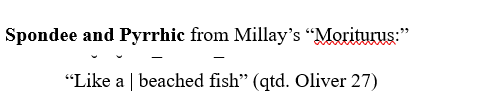
There are two uncommon metrical feet in poetry: the spondee and the pyrrhic, which are exceptions to the rule of having one stress in a foot (Oliver 17, 27, 11). The spondee, unlike the other metrical patterns, has two syllables that are equally stressed, denoted by horizontal lines (¯) in scansion (Oliver 17). The pyrrhic, on the other hand, is less common than the spondee, and is its opposite, a two-syllable foot where neither syllable is stressed (Oliver 27). Additionally, when a pyrrhic foot is used in English verse, Oliver says it is “[always] followed by a spondee” (27).
Substitution
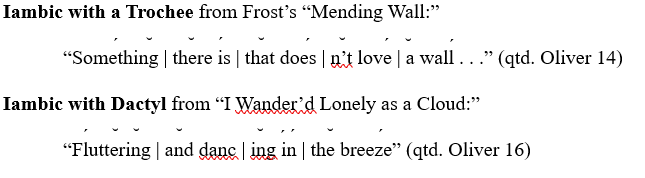
Contrary to the strict metrical pattern in the iambic and anapestic examples above, “substitutions are allowed” (Oliver 13). Oliver further explains the ability to substitute in writing by laying out a general rule: “Any of the four patterns given may at any time be substituted for any other” (Oliver 14). She later adds spondees to this list (Oliver 18).
Tags
A tag changes the end of the line by adding an unstressed syllable after the ending stressed syllable (Oliver 22). In iambic or anapestic meter, this change creates a feminine (unstressed) ending rather than a masculine (stressed) one (Oliver 21-22).

Impure Meter
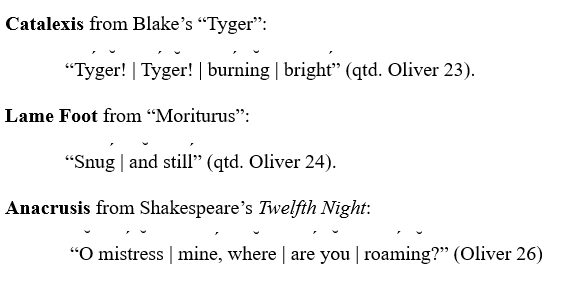
Unlike the previous three changes to metrical patterns, impure meter is a “regular,” or pervasive change to meter (Oliver 22). Since there are too many of these types to fit into this blog, I will only include three: catalexis, lame foot, and anacrusis. Catalexis removes the unstressed syllable from the final foot, creating a catalectic foot, with a masculine ending instead of a feminine one (Oliver 23). A lame foot is the opposite of catalexis. Instead of shortening the last foot, it occurs when any other foot is shortened (Oliver 24). Finally, an anacrusis is like the lame foot, except that it adds an unstressed syllable to the first foot (Oliver 26).
Conclusion
Meter has transformed the way I write poetry. Since discovering it through my poetry class, I have written most of my poems in a strict meter. However, Mary Oliver’s Rules for the Dance has helped me rediscover and redefine how I use meter in writing, allowing substitutions or even impure meter when best suited to the poem. I hope this discussion of meter helps you read and write metered poems, as it has for me.
Works Cited
Oliver, Mary. Rules for the Dance: A Handbook for Writing and Reading Metrical Verse. HarperCollins Publishers, 1998.